
Full Spectrum vs Broad Spectrum CBD
Cannabidiol (CBD) has been the subject of a great deal of interest in recent years due to its potential therapeutic uses and its increasing presence in the wellness sector. It’s a naturally occurring cannabinoid found in the cannabis plant, and unlike THC, it doesn’t produce the characteristic ‘high’.
CBD products are available in a variety of formulations, with Full Spectrum and Broad Spectrum CBD being two of the more commonly encountered. They both contain CBD, of course, but they differ in their cannabinoid profile, specifically in the presence or absence of THC.
Understanding the difference is important for the consumer, for the researcher, and for the business that is selling the product. This guide looks at Full Spectrum and Broad Spectrum CBD, what they are, what they may offer, and the key differences between them.
What Is Full Spectrum CBD?
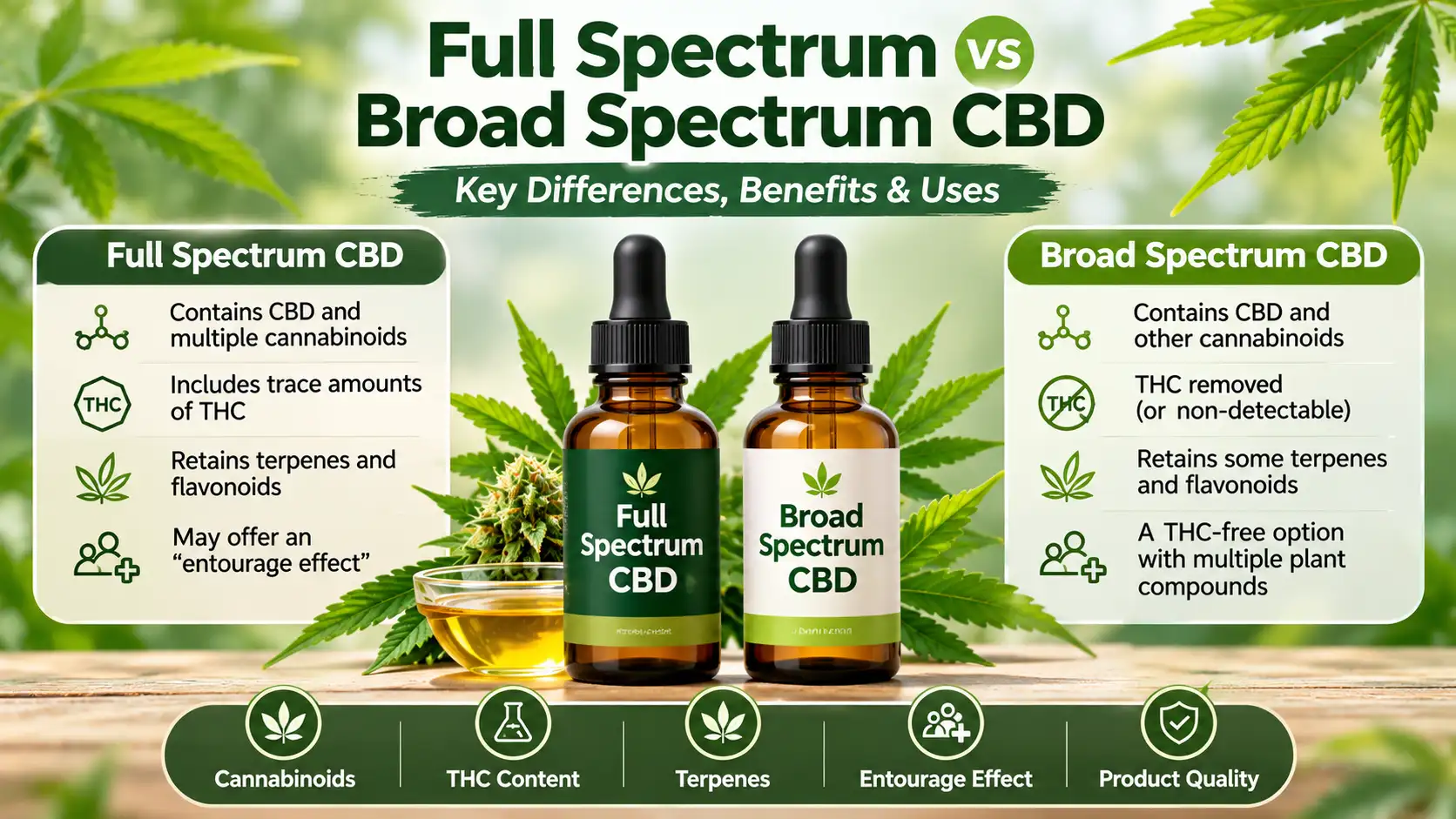
Full Spectrum CBD is a cannabis-derived extract that contains cannabidiol along with other naturally occurring compounds found in the cannabis plant. These may include minor cannabinoids, terpenes, flavonoids, and a small amount of tetrahydrocannabinol (THC).
Unlike CBD isolate, which contains predominantly purified CBD, Full Spectrum products retain a broader range of the plant’s chemical constituents.
Key Characteristics of Full Spectrum CBD
- Multiple Cannabinoids: It contains CBD alongside other cannabinoids, which may include CBG, CBN, and THC.
- THC: It will generally contain some THC, though the amount will vary depending on the source material and the relevant legal limits.
- Terpene Content: Naturally occurring terpenes may be responsible for the aroma and flavor of the product.
- Plant-Based Composition: It retains a wider range of naturally occurring cannabis compounds.
- Potential Entourage Effect: Researchers have investigated whether different cannabis compounds may interact to influence their overall effects. This proposed interaction is commonly called the entourage effect, although its clinical significance remains uncertain.
What Is Broad Spectrum CBD?
Broad Spectrum CBD is a cannabis-derived extract that contains CBD and several other naturally occurring plant compounds but is processed to remove THC to non-detectable or negligible levels, depending on the manufacturer and testing method.
It generally retains some minor cannabinoids and terpenes, making it different from CBD isolate.
Key Characteristics of Broad Spectrum CBD
- THC-Reduced Formulation: It is processed to remove THC, although the effectiveness of removal should be verified through laboratory testing.
- Multiple Cannabinoids: It may contain compounds such as CBG and CBN.
- Terpenes and Flavonoids: Some naturally occurring aromatic and plant compounds may remain in the extract.
-
Non-Intoxicating Composition: It is not generally expected to produce THC-related intoxication when THC is genuinely absent.
-
Alternative CBD Formulation: It is often marketed to consumers who want multiple cannabis-derived compounds without intentionally including THC.
Understanding the Entourage Effect
The entourage effect is a proposed concept suggesting that cannabinoids, terpenes, and other cannabis compounds may interact and influence their overall biological effects.
For instance, CBD, THC, and various terpenes may have quite different properties when studied on their own. The question being asked is whether the presence of all of them together has an effect that is different from the effect of the individual compounds.
Full Spectrum CBD contains a wider range of cannabis compounds, including THC, while Broad Spectrum CBD may retain several compounds after THC removal.
However, it is important to note that the entourage effect is still being researched. Strong clinical evidence establishing that Full Spectrum CBD is consistently more effective than Broad Spectrum CBD is currently limited.
Potential Benefits of Full Spectrum CBD
Full Spectrum CBD is marketed for a number of potential wellness applications as it contains a range of cannabis derived compounds.
Some areas of scientific interest include:
- Pain and Inflammation Research
CBD and the other cannabinoids are being looked at for their potential to interact with the biological pathways involved in pain and inflammation. There’s still insufficient evidence to support the use of many of the CBD products on the market for the purpose of general pain relief.
- Relaxation and Stress Research
CBD has been looked at in terms of its potential effects on anxiety-related processes. The research is still in its infancy, and Full Spectrum CBD products are not established treatments for anxiety.
- Sleep-Related Research
Researchers are looking at whether CBD and the other cannabinoids may have an effect on sleep. The results are mixed, and more controlled human studies are required.
- Combined Plant Compounds
Full Spectrum CBD retains several naturally occurring cannabis compounds. Researchers are studying whether these compounds interact in ways that may influence their biological activity.
Potential Benefits of Broad Spectrum CBD
Broad Spectrum CBD is generally selected for its THC-reduced composition while retaining other cannabis-derived compounds.
Potential areas of research include:
- CBD Without Intentional THC Inclusion
Broad Spectrum formulations are designed to remove THC, making them an option for consumers seeking CBD products without intentionally including this cannabinoid.
- Multiple Cannabinoid Content
Depending on the formulation, Broad Spectrum CBD may contain several minor cannabinoids alongside CBD.
- Retention of Terpenes
Some Broad Spectrum products retain naturally occurring terpenes, which contribute to their aromatic profile and are being investigated for their biological properties.
- Alternative Product Formulation
Broad Spectrum CBD offers a different chemical composition from both Full Spectrum extracts and CBD isolate, giving manufacturers flexibility in developing different formulations.
It is important to remember that these characteristics do not establish that Broad Spectrum CBD is safer or more effective for particular health conditions.
Which Is Better: Full Spectrum or Broad SpectrumCBD?
There is no universally superior option because the two formulations have different compositions and considerations.
Full Spectrum CBD contains a wider range of cannabis-derived compounds, including some THC. Broad Spectrum CBD is processed to remove THC while retaining other compounds where possible.
The decision comes down to a number of factors: the composition of the product, your own level of sensitivity, any legal requirements, potential for drug interactions and the potential for THC exposure.
Consumers should also be aware that just because a CBD product is plant-based doesn’t mean it’s automatically safe. CBD can interact with a number of prescription medications and can have side effects including drowsiness, diarrhea, and altered liver enzyme levels.
Pregnant and breastfeeding individuals should avoid CBD products unless specifically advised otherwise by a qualified healthcare professional.
How to Identify Quality CBD Products
The quality and chemical composition of CBD products can vary considerably between manufacturers. Responsible product evaluation involves checking several important factors.
- Third-Party Laboratory Testing
Look for an independent Certificate of Analysis (COA) that verifies cannabinoid concentrations and checks for contaminants.
- THC Concentration
Check whether the product contains detectable THC and whether its concentration complies with applicable legal requirements.
- Ingredient Transparency
Reliable manufacturers should be up front about their ingredients, their extraction method, their cannabinoid content, and their product specification.
- Contaminant Screening
Lab reports should ideally contain testing for pesticides, heavy metals, residual solvents, and microbial contamination.
- Regulatory Compliance
CBD products must comply with the applicable regulations in the country where they are manufactured, marketed, sold, or consumed.
Conclusion
Full Spectrum and Broad Spectrum CBD are two very different things in terms of their chemical makeup. Full Spectrum CBD will contain a number of the naturally occurring compounds that are found in the plant (including some THC). Broad Spectrum CBD is processed to remove the THC, with the intention of retaining as many of the other cannabinoids and plant compounds as possible.
Both formulations have generated interest in the burgeoning CBD industry, particularly in light of the ongoing research into cannabinoids and their potential biological effects. The scientific basis for many of the claimed wellness benefits, however, remains very limited.
Understanding the cannabinoid profile, the lab testing, the product quality and the relevant regulations is absolutely fundamental when you’re looking at CBD products. As the research continues to develop, accurate information and a transparent manufacturing process will be key to the responsible development of the CBD industry.